
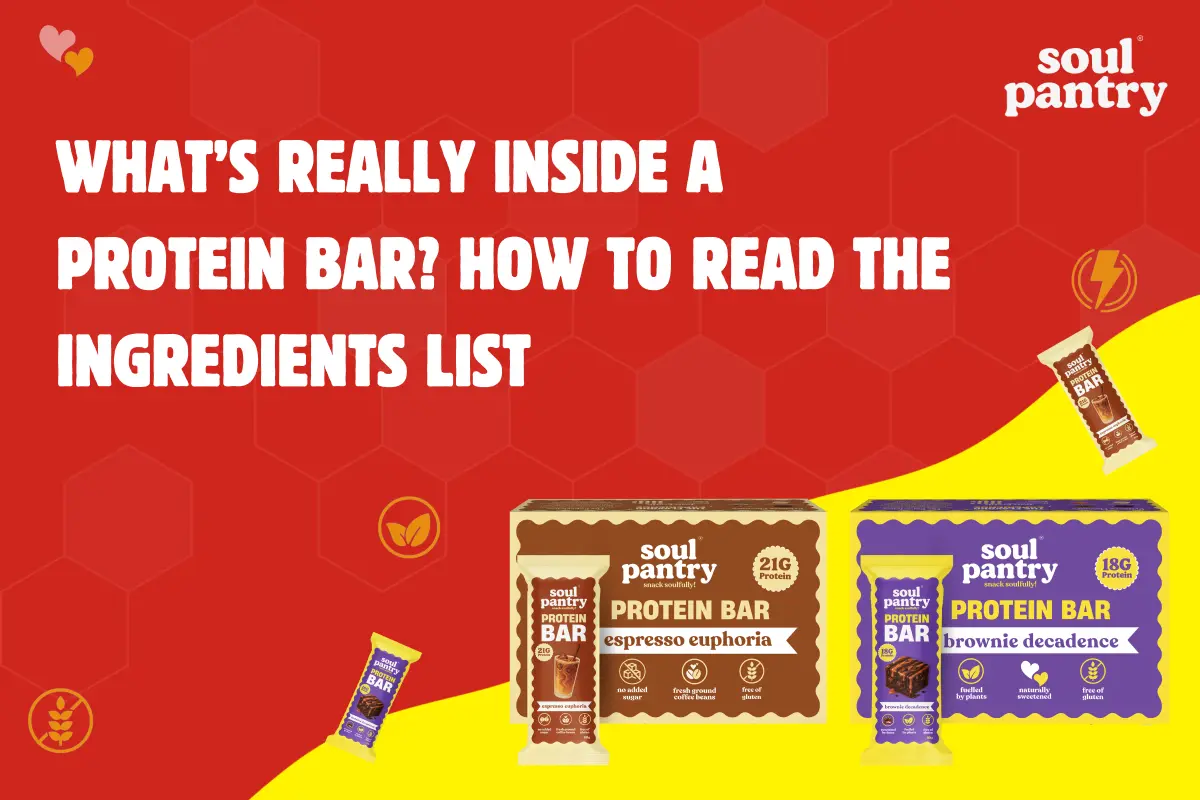
What’s Really Inside a Protein Bar? How to Read the Ingredients List

Turn a protein bar over and you’ll usually find forty words you don’t recognise, arranged in an order nobody explains.
Most of it is harmless. Some of it tells you exactly what you’re holding. And two or three items decide whether the bar is worth what you paid.
Here’s how to read one in about thirty seconds.
Read the order, not just the words
Ingredients are listed by weight, heaviest first. That one rule does most of your work for you.
If the first thing on the list is a protein blend, you’re holding a protein bar. If the first thing is a syrup, dates or chocolate, you’re holding a confectionery bar that also contains protein. Neither is wrong, but only one of them is what the packaging is implying.
The protein blend is the first thing worth reading
Look at what’s inside the brackets. A single protein source on its own is weaker than a blend, because one plant protein can be short on an amino acid or two, and a blend covers what it’s missing.
You’re also looking for what the protein actually is. Whey concentrate and whey isolate are dairy. Pea, soy, brown rice and green gram are plants. Brands rarely spell that out on the front, and it matters if you’re avoiding one of them, which we went through in the plant protein versus whey comparison.
The sugar question is really a sugar alcohol question
This is where you’ll find most of what’s interesting, and where “sugar free” earns its quotation marks.
A bar with 1g of sugar has usually replaced it with something. Most often that’s a sugar alcohol, and on a UAE label you’ll see maltitol, erythritol or xylitol, sometimes written as an INS number like INS 965 rather than a name.
What sugar alcohols actually do
They sweeten with fewer calories than sugar and they don’t spike your blood glucose the way sugar does. That’s the genuine benefit and it’s why the category exists.
The trade-off is digestive. In quantity, maltitol in particular can cause bloating or worse, and people vary enormously in what they tolerate. One bar is fine for most of us. Three in an afternoon is how you find your limit.
So when you see a very low sugar number on a sweet-tasting bar, don’t stop there. Read on and find out what’s doing the sweetening, then decide whether that suits you.
Ours use it and we’d rather say so. Both bars are coated in a sugar-free dark chocolate sweetened with maltitol. Brownie Decadence carries 1.6g of total sugar and no added sugar, and Espresso Euphoria 0.8g. The low sugar figure is real, and this is how it’s achieved.
Fibre is not always what you think
Check where your fibre is coming from, because there’s a difference between fibre that was in the food and fibre that got added to improve the label.
FOS, or fructooligosaccharides, is a common one. It’s a prebiotic fibre that also tastes faintly sweet, which is why it does double duty in a lot of bars. Chicory root inulin is the other one you’ll see constantly.
Neither is a problem. Both are genuinely fibre, and fibre is the thing that makes a protein bar hold you rather than just feed you, which we covered in how much protein a snack should have. Just know that a high fibre number on a bar is usually added rather than inherent, and that added prebiotic fibre in quantity has the same digestive ceiling as sugar alcohols do.
The coating is where the fat sits
On most bars, the chocolate coating carries a meaningful share of the fat and the calories. That’s not a flaw, it’s how a bar ends up tasting like a bar.
Worth knowing, because two bars with the same protein can differ by eighty calories purely on how thickly they’re coated. So when you’re comparing, compare the calories and the fat too, not the protein alone.
Coating also decides whether the bar survives a UAE summer, which is a separate question we went through in the snack box guide.
Emulsifiers, glycerine and the short words at the end
The tail of the list is the bit that looks most alarming and it’s usually the least important thing there.
Soy lecithin, listed as INS 322, is an emulsifier that stops fat and cocoa separating. Vegetable glycerine keeps a bar soft rather than brick-like. Rosemary extract, which turns up at the very end of a lot of lists, is there as a natural preservative for freshness.
They sit at the end because there’s very little of them. They’re doing texture and shelf life rather than nutrition, and they’re not your reason to put a bar back.
What ours say, in full
There’d be no point writing you a guide to reading labels and then hiding our own.
Brownie Decadence leads with a protein blend of pea protein isolate, soy crispies and soy protein isolate, then a sugar-free dark chocolate sweetened with maltitol, a sugar-free caramel using erythritol, date paste, FOS, cocoa butter and oats flour. Per 60g bar: 18g protein, 4.5g fibre, 254 calories, 1.6g total sugar, no added sugar.
Espresso Euphoria leads with whey protein concentrate, whey protein isolate, soy crispies, whey crispies and milk protein isolate, then the same sugar-free dark chocolate, rice bran oil, FOS, almonds, oats, flax seeds, cocoa and coffee powder. Per 60g bar: 21g protein, 8.8g fibre, 248 calories, 0.8g total sugar, no added sugar. It’s dairy based and it contains almonds.
Two bars, two completely different protein sources, same brand. That’s your whole argument for reading the list rather than the front. If you want the full range side by side, the numbers are on each product page.
The thirty second routine
One. Read the first three ingredients. Protein blend first is what you want.
Two. Check the protein per serving and the serving size together, not per 100g.
Three. Look at total sugar, then find what replaced it.
Four. Check fibre, and note whether it’s added or inherent.
Five. Glance at calories and fat, which is mostly a coating question.
Everything after that is texture and shelf life.
The Takeaway
The front of a protein bar is written by marketing. The back is written by regulation, which is why it’s the more honest side.
Read the order of the ingredients, find the protein source, work out what’s doing the sweetening, and check whether the fibre was added. Five things, thirty seconds, and you’ll stop buying confectionery that’s wearing a gym vest.
And if a brand won’t print its full ingredients list on the product page, that’s your answer without reading anything.
FAQs
What should be the first ingredient in a protein bar?
The protein blend. Ingredients are listed heaviest first, so if a syrup, dates or chocolate comes first, protein isn’t the main event in that bar however large the number on the front is.
Are sugar alcohols in protein bars bad for you?
Not inherently. They sweeten with fewer calories and don’t spike blood glucose like sugar. The trade-off is digestive tolerance, which varies a lot between people, and maltitol is the one most often reported as causing bloating in quantity.
What is FOS in a protein bar?
Fructooligosaccharides, a prebiotic fibre that’s also mildly sweet, which is why it appears in so many bars. It counts as fibre and it’s doing two jobs at once.
Why do protein bars have so many ingredients?
Because a bar has to be sweet without sugar, soft without going stale, and hold together at room temperature. Most of the long tail of the list is emulsifiers, humectants and preservatives doing texture and shelf life rather than nutrition.
Is soy lecithin in a protein bar a problem?
For most people, no. It’s an emulsifier listed as INS 322 that keeps the fat and cocoa from separating, and it sits near the end of the list because there’s very little of it. It is soy-derived, so it matters if soy is one of your allergens.
How do I compare two protein bars quickly?
Protein per serving, then fibre, then total sugar and what replaced it, then calories. Two bars with identical protein can differ by eighty calories on coating alone.