

Low-Calorie Snacks That Don’t Leave You Hungry an Hour Later

You’ve done this. You pick the snack with the smallest number on the front, eat it at three, and by four you’re back at the cupboard looking for something else.
So you ate the low-calorie snack and then you ate the other thing too. The maths got worse, not better.
The problem isn’t your willpower. It’s that calories on their own tell you almost nothing about whether a snack will hold you.
Why the lowest number is the wrong target
A 90 calorie snack that leaves you hungry in twenty minutes costs you more than a 190 calorie one that holds you until dinner. You’ll eat the difference and then some.
Most very low calorie snacks are mostly air, water or fast carbohydrate. They’re through your stomach quickly, and once they’re gone you’re back where you started, except now it’s 4pm and your judgement isn’t what it was.
So the question isn’t how few calories you can get away with. It’s how much hunger each calorie is buying you.
The two numbers tha t decide it
Protein. It leaves your stomach more slowly than fast carbohydrate does, which flattens the drop instead of adding another spike to it. Fifteen grams is the point where you notice.
Fibre. It adds bulk and slows things further. Five grams or more per serving is the bar worth holding a snack to.
Get both in the same snack and a moderate calorie count’ll beat a tiny one every time. Get neither and you’ve bought yourself twenty minutes.
The thresholds are worth knowing properly, and we went through them in how much protein a snack should have.
The test that takes five seconds
Divide the protein by the calories and multiply by 100. That gives you grams of protein per hundred calories, and it sorts a shelf faster than reading the front of anything.
Under 3g per 100 calories. It’s a normal snack. It might be low in calories and it won’t hold you.
Between 4g and 6g. Respectable, and where most genuine options sit.
Above 7g. Properly dense. This is the range where a moderate calorie count does real work.
Then do the same glance at fibre. A snack clearing 7g of protein per hundred calories with 5g of fibre is doing the job that 90 calorie rice cake was only pretending to do.
What actually holds you between meals
Anything savoury with protein built in. The 3pm craving is usually salt rather than sugar, and a savoury option with real protein ends it properly. Most low calorie ranges are overwhelmingly sweet, which is why people bounce off them by week two.
Portioned nuts. Genuinely filling, genuinely calorie dense, and impossible to eat sensibly from a large bag. Single serves or nothing.
Roasted chickpeas and edamame. Cheap, crunchy, high fibre, boring in the best way.
Greek yoghurt, if you’ve got a fridge. Excellent between meals, useless as a desk drawer plan, and the desk drawer is the gap most of us actually need to fill.
Fruit with something alongside it. An apple on its own is an apple. An apple with a few nuts is a snack that holds.
What to stop buying
Rice cakes on their own. Almost no protein, almost no fibre, and gone in half an hour.
Anything marketed as light or diet with under 5g of protein. The calorie saving is real and it buys you nothing.
Fat-free flavoured yoghurts. The fat comes out, sugar usually goes in, and the fullness goes with it.
Large bags of anything. The calorie count per serving stops meaning anything the moment nobody is measuring a serving.
Where ours land, honestly
We’d rather hand you the real numbers than call everything we make low calorie.
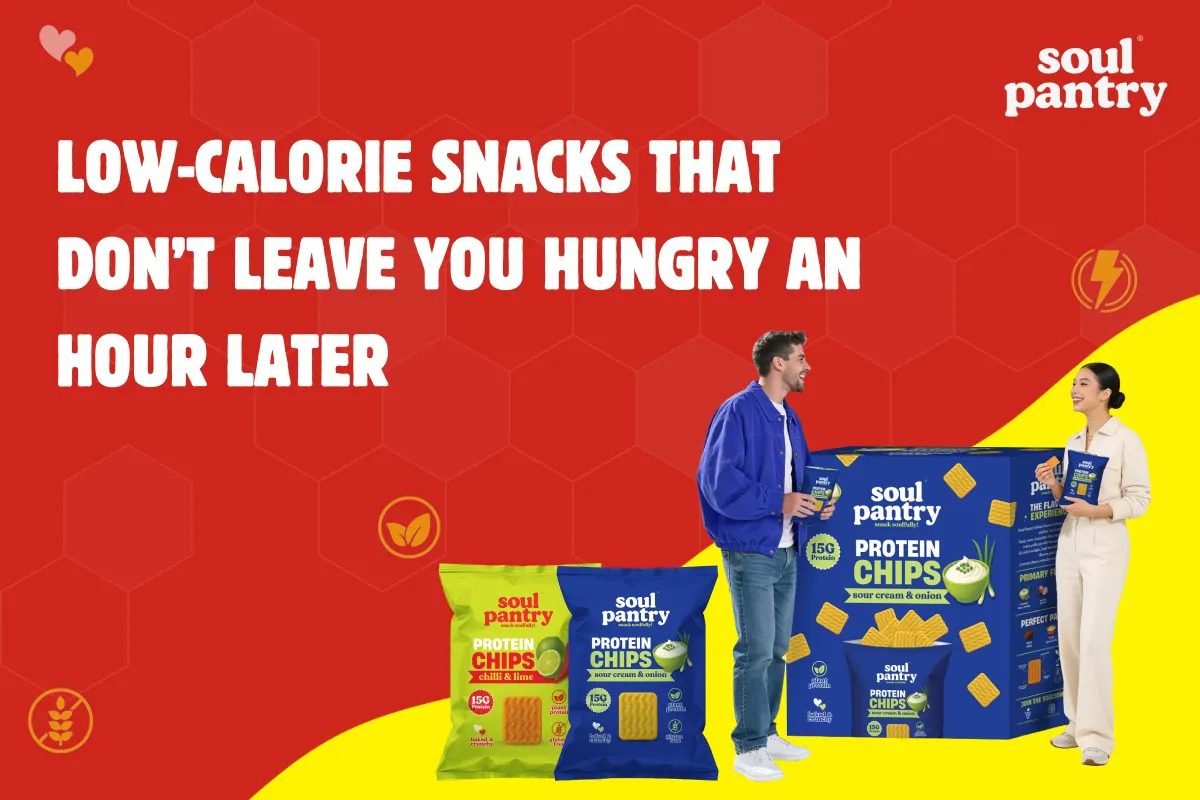
The protein chips are the ones that fit this brief. A 50g serving is 192 calories with 15g of protein and 5.5g of fibre, and just 0.2g of total fat. That works out at roughly 7.8g of protein per hundred calories, which clears the bar comfortably, and they’re baked rather than fried, gluten free and savoury, which covers the craving most low calorie ranges ignore.
The protein bars are a different proposition and it would be misleading to pretend otherwise. Brownie Decadence is 254 calories and Espresso Euphoria 248. Those aren’t low calorie snacks, they’re substantial ones, and they earn that when a snack is standing in for a meal you’re about to skip or landing after training. Espresso Euphoria carries 21g of protein and 8.8g of fibre, so the calories are working, but it’s a bigger snack and you should choose it deliberately.
That’s the honest split. For the afternoon gap, the chips. For a replaced meal, a bar.
Build the gap out of your day
The last piece is placement, because most of this gets decided by what’s within reach when you stop thinking.
Keep one savoury option and one sweet at your desk or in the cupboard, portioned, so the 3pm decision is already made. Buy a mix rather than a big box of one thing, because the box of one gets boring by week two and then gets ignored, which we went through in the snack box guide.
And eat the snack at three rather than holding out until five. The point of it is to stop the enormous dinner, and that only works if it arrives before you’re starving.
The Takeaway
Stop shopping for the smallest number. Shop for the snack that buys you the most hours per calorie.
That means at least 15g of protein and 5g of fibre in the same serving, a protein-to-calorie ratio above about 4g per hundred, and something savoury in the mix so the afternoon craving has an answer.
A 192 calorie snack that gets you to dinner is a cheaper afternoon than a 90 calorie one that gets you to 3:20.
FAQs
What are the best low calorie snacks that actually fill you up?
Ones carrying at least 15g of protein and 5g of fibre in the same serving. Protein and fibre together slow digestion, which is what fullness actually is. Calories alone don’t predict it.
How many calories should a snack have?
There isn’t one number. A snack between meals in the 150 to 200 calorie range with real protein will usually beat a 90 calorie one, because you won’t be eating again an hour later.
Why am I still hungry after a low calorie snack?
Almost always because it was low in protein and fibre. Rice cakes, crisps and most light snacks clear your stomach quickly and leave nothing behind to slow the next craving.
Is a protein bar a low calorie snack?
Usually not. Most sit between 200 and 260 calories, which makes them a substantial snack rather than a light one. They’re a good choice when replacing a meal or refuelling after training, and a heavy one for a small afternoon gap.
What is a good protein to calorie ratio?
Above 4g of protein per hundred calories is respectable and above 7g is genuinely dense. Under 3g and the protein is incidental to whatever you’re really eating.
Are savoury or sweet snacks better between meals?
Neither is better nutritionally, but most people’s afternoon craving is savoury, and low calorie ranges are overwhelmingly sweet. Keeping a savoury option is usually what stops the vending machine trip.